












![Movie poster for '[Rec]" (2007).](https://www.lionnewspaper.com/wp-content/uploads/2023/04/rec-640x900.jpg)


Prom traditions evolve: art teacher, LION archives unveils history
Prom hasn’t always looked the way it does today. From slow beginnings during the Great Depression to nights featuring nationally known musicians and elaborate post-prom trips and venues, the tradition has changed dramatically over time.
Early proms at LT were far simpler than modern ones. While the first known prom was in 1931, the first reference, from 1932, describes an event during the Great Depression for junior and senior students, art teacher and unofficial LT historian Patrick Page said.
“The Prom is going to be very informal this year,” a 1932 LION article reported. “The committee is trying to cut down on the expenses this year, so the prom will be as simple as possible. There will be a program in the auditorium.”
Many early dances were held at the school itself, sometimes in foyers or community rooms. Despite this, many activities were involved.
“[The] program is in three parts: two in singing duet, exhibition waltz, County Fair [with] hog calling, races, [then] the dance,” a 1935 LION article detailed.
As time went on, prom moved beyond school grounds into more formal locations. By the late 1930s, events were being hosted at places like the La Grange Country Club. In the following decades, venues became increasingly upscale, including Chicago locations such as the Aragon Ballroom, the Sheraton Hotel, and the Palmer House, making it a larger-scale event.
“For the first time in many a year, the Prom is to be held downtown,” a 1946 LION article said.
In the 1940s, students went to great lengths to fund prom and new venues. Classes organized massive paper drives, collecting tens of thousands of pounds of paper. At one point, 200 pounds of paper could earn a student a free ticket. Paper drives were wartime fundraising activities, providing necessary funds for schools while contributing to the war effort through material conservation.
“38 tons of paper collected,” a 1941 LION article said. “This should bring the senior class of 1941 about $100 more than was received by the class of 1940 in their paper drive.”
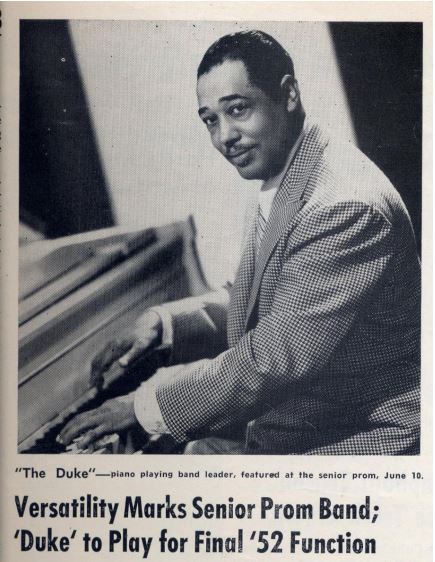
One constant throughout the decades was live music, Page said. Proms featured full orchestras well into the 1970s, with students often voting on which bands would perform. Some performers were nationally recognized.
“June 10, at the Sheraton hotel, ‘Duke’ Ellington will be the leader of the senior Prom band,” a 1952 LION article said. “Ellington is world famous for his concerts and engagements.”
Prom traditions also extended beyond the dance itself as they do now. Instead of close destinations like the current Navy Pier, much farther places were booked. Past post-prom destinations include the Indiana Dunes, Lake Geneva, Eagle Point Park in Dubuque, Iowa, and various nightclubs and lakeside resorts. Attempts to organize official post-prom activities began in the 1950s but weren’t always successful. One planned trip in 1959 was canceled due to low interest. That changed in 1965 with the introduction of a large, organized trip known as the “Cannonball ’65,” costing students $12. Students boarded a chartered train in the early morning hours for a full day at a resort.
“The special ‘Cannonball ‘65’ will transport class members into never-never land, which is, in this case, a 250-acre resort along the Mississippi,” a 1964 LION article reported. “An 18-car train, including baggage cars for music and dancing, snack cars, and passenger cars, has been chartered.”
Although there have been immense changes to prom that have occurred in the last century, in recent years, besides the canceled COVID-19 year (2020), prom has faced few changes, as transportation, post-prom, and venues remain the same throughout.
Class Board plans prom: students explain processes for senior dance
A botanical function is set to blossom on May 16 at the Field Museum in Chicago, with the 2026 Class Board selecting the “Garden Gala” theme just weeks ago, but how are these elegant–and occasionally controversial–themes selected each year?
The Class Board is the only group involved in planning the celebrations. President of the Class of 2026 Class Board Paxton Cutler ‘26 heads the months-long process of selecting the prom theme.
The board begins with brainstorming ideas, themes ranging from traditional to extravagant, and the board considers what will be affected by the theme, including decorations and food. Last year’s theme, “Greek Islands,” had a substantial impact on these considerations. This year’s theme, however, was purposely chosen to allow the board to have more opportunity for food, and the theme will mostly affect the decorations and centerpieces at the museum, Cutler said.
Favorite themes are then sent to the Board of Education and the principal, and the administration must authorize the theme. This can be a difficult process, Cutler said, as the approval process is lengthy and genuinely considered by the board.
Once approved, the board can get to work on planning the event, from music to the general setup. Exhibits at the museum are free to explore, and celebrations include lots of dancing, a DJ, and delicious food. As mentioned, this year’s food is practically unaffected by the theme besides flower cupcakes and a garden salad, Cutler said.
As president of the board, Cutler leads and contributes to the group’s decisions. Decisions are student-led, and teacher influence is limited.
The class board visits the Field Museum during their junior year to take a first glance at the facility, co-sponsor for the Class of 2026 Class Board Sylvia Tanious said. Students set up centerpieces and get an idea of the layout and flow. During their senior year, the board gets a chance to tour the museum and see what exhibits they would like to keep open during the event. They also finalize the menu and table linens with the catering team.
The administration’s approval process is long, but they provide feedback and edits until a final decision is agreed upon. Tanious agrees that this year’s theme has less of an effect on the entirety of the event.
“The theme really only has a slight influence on some menu selections and centerpieces, really, the theme of the night should be celebrating the culmination of high school and graduating,” Tanious said.
Secretary of the board Margot Berg ‘26 has the responsibility of creating virtual vision boards for the top themes. Ideas are presented to prom coordinator Shannon Eddy, who then takes the ideas to the school board, Berg said.
The brainstorming portion of the process took a few months, beginning in September, and the official decision was made in January.
“The theme was super tricky to decide on, [as] we had to consider all students since prom focuses on all seniors,” Berg said. “We also need to consider how food and decorations will correlate with it.”
Prom is set for May 16 at the Field Museum in Chicago from 8-11 p.m., with the post-prom cruise on the Chicago River taking place from 11:45 p.m. to 2:30 a.m.
Three teachers recount their time at LT, what made them come back
LT has an especially high number of teachers who attended as students and later returned to educate a new generation. Three educators, all LT alumni, spoke about their memories and what brought them back to NC and SC.
Anne Marie Leader ’86, a NC history teacher from La Grange Park, attended LT from 1982 to 1986. Her high school years took place during the Cold War and were marked by major events like the Challenger space shuttle disaster, Ronald Reagan’s reelection, the release of Michael Jackson’s “Thriller,” the Chicago Bears’ Super Bowl XX win, and popular films such as “Top Gun” and “E.T.” As a Lion, Leader played on the girls tennis team and later continued her career at the University of Minnesota. Leader took an art class every semester and also attended Art Club.
“I loved art. That was one of my favorite class periods, too, to go to art and draw and paint,” Leader said. “I love sports, and I love art.”
Academically, Leader excelled. Accelerated classes were called “Superior,” and preparatory classes were called “Regular.” She was usually enrolled in the former, with AP U.S. History being one of the first AP classes she took—a class she teaches today.
Originally interested in journalism, Leader switched to teaching at age 26 after substituting for a teacher on early maternity leave, eventually earning a full-time position the next semester.
Spanish teacher Kristie Scriba ’84 attended LT from 1980 to 1984 and recalls physical similarities but social differences between then and now. Scriba was part of LT’s Girls Club, which helped organize dances and other events. Additionally, Scriba was a cheerleader for the Lions and served on the 1984 Class Board. Something she believes has always been special about LT is its dual campuses. As a teacher who intentionally commutes between NC and SC, she said she enjoys the different atmospheres of each.
Overall, Scriba’s time at LT was special because of the relationships she developed there. Scriba’s husband was her prom date, and she formed friendships that continue to this day.
“My best friend went here,” Scriba said. “[I’ll always remember] the friendships that are here. That’s something that I love that happened here and that I still love today.”
English teacher Frank Alletto ’92 attended LT from 1988 to 1992 and later returned as a teacher, inspired by his former English teacher, Glen Brown. A strong student, Alletto said he took mostly honors classes and aimed to become a high school teacher.
During a time of hair bands, the emergence of the World Wide Web, and the dissolution of the Soviet Union, Alletto took pride in being a Lion as a member of the tennis team and choir. Alletto was especially involved in a community youth group at Emmanuel Episcopal Church in La Grange, nicknamed “The Swamp” because the basement frequently flooded. Many choir members were also part of the group, and Alletto developed lasting friendships with them.
Alletto recognizes a strong sense of school pride, both today and during his time as a student. According to Alletto, the sense of community at LT has persisted for the past 38 years.
“I hadn’t thought about it much before, but the choice of a lion as a mascot is really appropriate,” Alletto said. “This place has been around since 1888, and I loved my time here. I really do think LT students and teachers have always known how incredibly good they have it.”