










![Movie poster for '[Rec]" (2007).](https://www.lionnewspaper.com/wp-content/uploads/2023/04/rec-640x900.jpg)

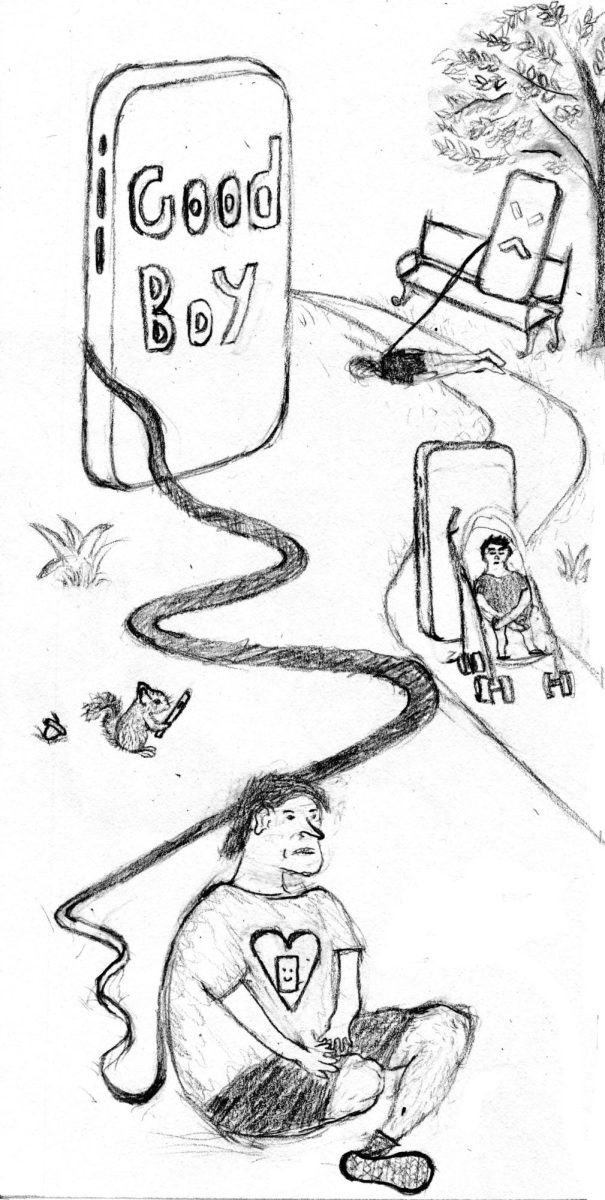
Gerry James, Fine Arts Division Chair, remembers when he was a kid, they fought over the one computer in the library to play Oregon Trail. He has witnessed part of technology’s evolution throughout his lifetime. He has become very curious about A.I. in art and is holding a case study in April for his PhD to examine the impact of A.I. in art.
“I have really strong feelings [about A.I.],” James said. “I am an educator who has always been what I would call tech-forward, but with each new and changing piece of technology, it’s always a balance between how it assists learning in the classroom and pitfalls that we may need to watch out for. I like to think I value curiosity over fear when it comes to being an educator, so with A.I., I do think there is great benefit.”
James has been a teacher for 20 years, and this is his fourth year as the Fine Arts Division Chair at LT. He oversees art, music, and world languages. He is working on his PhD in art education.
James is partnering with Mary Rohlicek, LT South Campus art teacher and Menagerie art advisor, to conduct the case study on A.I. in high school art.
“We are going to work together, and with my drawing classes, we are going to have them use A.I. on one of their projects,” Rohlicek said. “The concept will be that the student has already created the project, and we will take a picture of it, put it into AI, and ask how it can be improved.”
It is a voluntary opportunity for art students to have their voices heard about the presence of A.I. in the classroom and art. The case study is through Northern Illinois University.
“I think in some ways it can be a tool, but we also want students to have their own thoughts and designs,” Rohlicek said.
It will be a four-week project that is presented to the classes after spring break to gauge student interest. There will be a controlled environment and an experimental variable. One drawing class will do the project without the assistance of A.I., and the other class will do the project with the resource.
“In general, I would say I’m not very fond of A.I.,” Aria Lyons, ‘29 art student, said. “I do think that certain types of A.I. can be very beneficial, such as machine learning, which learns from patterns and updates its algorithm based on experience. However, generative A.I. is where I draw the line. Art can represent so many emotions and experiences in many different ways, and A.I. generated art lacks the one thing that gives it meaning: humanity.”
Many students have mixed feelings about A.I. The experiment is open to all students’ opinions. It aims to collect a variety of data on A.I. in high school art.
“Using A.I. to critique art takes away the creativity and makes it unfair to those who are passionate about art and have taken the time to become skilled at creating,” Lyons said.
A.I. is becoming very prevalent in society, and James is finding ways to acknowledge it in the school community.
“There can be a lot of trepidation towards A.I. because of its environmental and privacy impact, but I like to try to find a way to utilize those technologies safely and appropriately in the classroom,” James said.